Om Namah Shivaya — Panchakshara Mantra
Meaning, pronunciation and the long-form five-syllable Shiva chant
Om Namah Shivaya is the best-known Shiva mantra of all — the five-syllabled Pañcākṣara, Namaḥ Śivāya, here preceded by Oṃ. It holds the whole of surrender, and is chanted by beginners and lifelong practitioners alike, at temples, on a mālā, and in the quiet before sleep.
Pañcākṣara — the five-syllable mantra of Shiva · 2h 26m chant
Listen
This is Spiritual Awakening's own long-form recording — the official way to listen. There is no separate audio hosted on this page.
Best suited for: A first Shiva mantra for beginners · Daily japa on a mālā · Steady meditation and slow breathing · Calm listening before sleep
Sacred text
Devanagari
ॐ नमः शिवाय
IAST transliteration
Oṃ Namaḥ Śivāya
Simple pronunciation
Om Na-mah Shi-vaa-ya
In this recording: The long-form recording repeats this single line as a continuous japa loop; the words do not change.
Meaning
I bow to Shiva — the auspicious one, the stillness at the heart of all things.
- Literal meaning
- Oṃ. Salutation to Śiva.
- Devotional interpretation
- Namaḥ Śivāya is the five-syllabled Pañcākṣara, and it carries the whole of surrender; in this recording it is preceded by Oṃ, forming the six-syllabled Oṃ Namaḥ Śivāya. To say it is to set down striving for a moment and rest in an auspicious presence that never leaves.
Word-by-word meaning
| Word | IAST | Literal meaning | Explanation |
|---|---|---|---|
| ॐ | Oṃ | the primordial sound | The sacred syllable that opens the mantra and gathers the mind. |
| नमः | namaḥ | salutation, I bow | Reverence and surrender — the letting-go of the separate self. |
| शिवाय | śivāya | to Śiva, to the auspicious one | 'Śiva' means the auspicious, the benevolent — the calm ground beneath all change. |
ॐOṃ
- Literal meaning
- the primordial sound
- Explanation
- The sacred syllable that opens the mantra and gathers the mind.
नमःnamaḥ
- Literal meaning
- salutation, I bow
- Explanation
- Reverence and surrender — the letting-go of the separate self.
शिवायśivāya
- Literal meaning
- to Śiva, to the auspicious one
- Explanation
- 'Śiva' means the auspicious, the benevolent — the calm ground beneath all change.
Translations are prepared with editorial review against the Sanskrit text, transliteration and English master meaning. Sanskrit words may carry layers of meaning that no single translation can fully express.
How to chant
Preparation
- Sit comfortably and let the breath slow.
- Read the pronunciation once before you begin.
Pronunciation notes
- Na-mah — the 'h' is a soft breath, not a hard stop.
- Shi-vaa-ya — the middle 'vaa' is gently lengthened.
How many times
Chant aloud, softly, or silently. Common counts are 11, 21, 27, or 108 (a full mālā), but any sincere number is fine.
To close
Sit quietly for a few breaths before you rise.
How to use the recording
Chanting along
Repeat the line gently along with the recording.
Meditation
Let the mantra be a single point of return whenever the mind drifts.
Prayer or pūjā
Play it during a simple home pūjā as a devotional backdrop.
Sleep listening
Keep the volume low and let it be the last sound of the night.
Morning practice
A few minutes at dawn to begin the day with a steadier mind.
Background atmosphere
Let it play softly while you read, tidy, or rest.
Background & sourcesClassification, origin, historical context, symbolism, intentions & occasions
What kind of sacred text is this?
This is a mantra — specifically the Pañcākṣara, the 'five syllables' na-maḥ-śi-vā-ya. With Oṃ added it is sometimes counted as six (Ṣaḍakṣara). It is the central mantra of the Śaiva tradition and the simplest doorway into it — not a prayer for a single outcome, but a name held in remembrance.
Origin and textual source
- Tradition / work
- The five syllables 'namaḥ śivāya' appear in the Śrī Rudram (Namakam)
- Section
- Kṛṣṇa Yajurveda, Taittirīya Saṃhitā 4.5.8 ('namaḥ śivāya ca śivatarāya ca')
- Attribution
- Vedic; traditional
- Variants
- Chanted with or without the initial Oṃ; both forms are widely used.
Historical and devotional context
Long before it became a household chant, 'namaḥ śivāya' was sung in the Vedic hymn to Rudra. Over centuries it became the heart-mantra of Śaiva devotion across India — carved on temple walls, taught to children, and repeated by renunciants. Its power lies in its plainness: everyone can hold it.
Devotees use it as a constant companion — a few rounds at dawn, a whispered line while walking, or a long sitting on the mālā. Because it asks for nothing in particular, it suits every mood: gratitude, grief, tiredness, or simple love.
Symbolism and inner meaning
- The five syllables are often linked to the five elements — earth, water, fire, air, and space — so the mantra is felt to hold all of creation.
- 'Śiva' as 'the auspicious' turns the mind toward what is good rather than what is lacking.
- Its very simplicity is the teaching: nothing needs to be added to reach the divine.
Traditionally associated intentions
Traditional purpose
- Remembrance and worship of Shiva
- A foundational mantra for daily practice
- Cultivating surrender and steadiness
Devotional intentions
- Surrender
- Devotion
- Inner peace
- Purification of mind
This recording is for
- Long-form japa
- Meditation
- Peaceful listening before sleep
- A quiet devotional atmosphere
A note on wellbeing: Many people find slow, repeated chanting settling and calming. This is a devotional and meditative practice — not medical treatment for any condition.
When is it traditionally chanted?
Monday and Maha Shivaratri
Shiva-centred days are natural times to chant more; the mantra suits any day with devotion.
Daily practice
A short round morning and evening keeps the remembrance alive.
Related mantras
 2h 30m
Mangalam Bhagwan Shambhu — Shiva Mangala Sloka
मंगलम् भगवान शम्भु, मंगलम् वृषभध्वज। मंगलम् पार्वती नाथो, मंगलम् तनो हर।।
 2h 31m
Karacharana Kritam — Shiva Kshama Prarthana
करचरण कृतं वाक्कायजं कर्मजं वा, श्रवणनयनजं वा मानसं वापराधम्। विहितमविहितं वा सर्वमेतत्क्षमस्व, जय जय करुणाब्धे श्री महादेव शम्भो॥
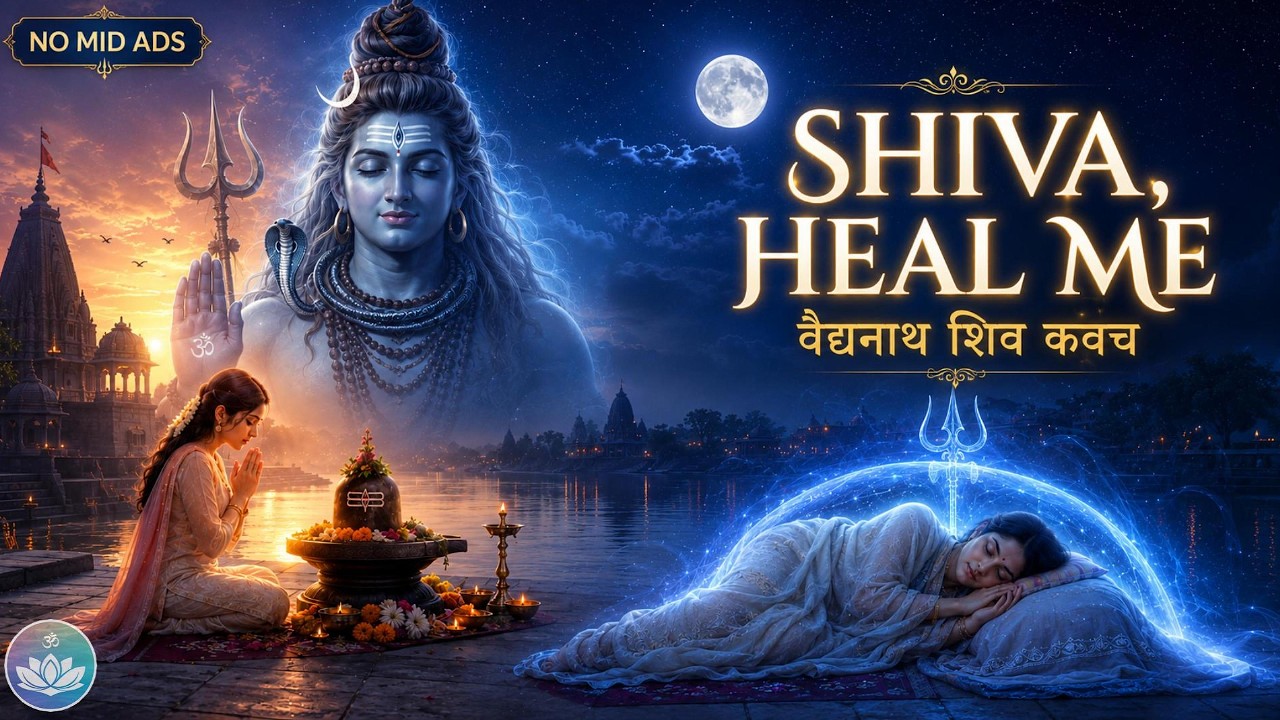 2h 30m
Vaidyanath Jyotirlinga Mantra
पूर्वोत्तरे प्रज्वलिकानिधाने सदा वसन्तं गिरिजासमेतम् । सुरासुराराधितपादपद्मं श्रीवैद्यनाथं तमहं नमामि ॥