Om Namo Bhagavate Vasudevaya — Meaning, Lyrics & Chant
The twelve-syllable Vishnu mantra of surrender and refuge
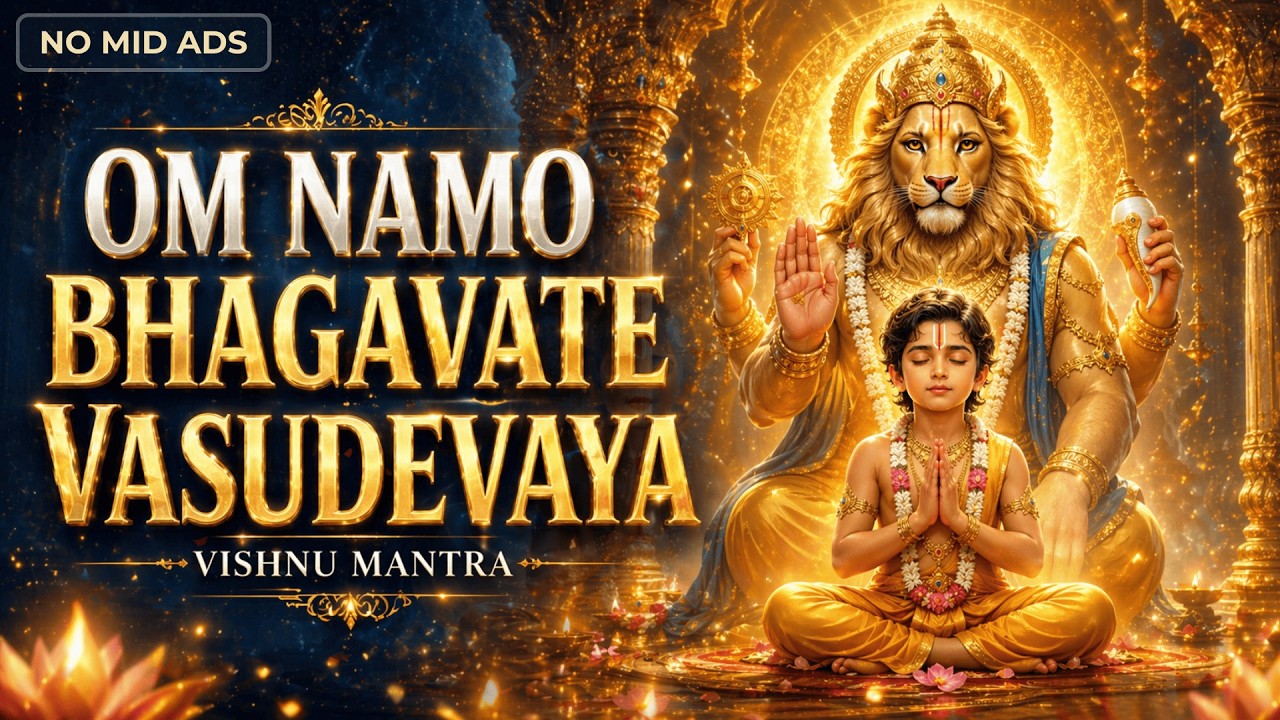
Om Namo Bhagavate Vasudevaya is the great twelve-syllable mantra of Vishnu-Vasudeva, long cherished as a mantra of surrender and refuge. In the Śrīmad Bhāgavatam it is the mantra the sage Nārada gives to the young prince Dhruva, to be the centre of his meditation on Vāsudeva.
Dvādaśākṣara — the twelve-syllable Vishnu mantra · 2h 4m chant
Listen
You're listening to the “Sleep Like a Baby” recordingof this mantra — one of Spiritual Awakening's own long-form recordings. There is no separate audio hosted on this page.
Best suited for: Daily japa on a mālā · Surrender and reassurance · Calm listening before sleep
Sacred text
Devanagari
ॐ नमो भगवते वासुदेवाय नमः
IAST transliteration
Oṃ Namo Bhagavate Vāsudevāya Namaḥ
Simple pronunciation
Om Na-mo Bha-ga-va-te Vaa-su-de-vaa-ya Na-mah
In this recording: The classic japa form is the twelve syllables 'Oṃ Namo Bhagavate Vāsudevāya'. This recording adds a closing 'namaḥ' — a common devotional way of rounding off the line. The core mantra is unchanged.
Meaning
I bow to Lord Vasudeva (Vishnu), the Supreme who sustains, protects, and pervades all creation.
- Literal meaning
- Oṃ. Salutation to Bhagavān Vāsudeva.
- Devotional interpretation
- A whole-hearted turning toward Vasudeva, the divine that lives in and holds everything. To repeat it is to lay down fear, as Dhruva did, and rest inside a protection that does not depend on us.
Word-by-word meaning
| Word | IAST | Literal meaning | Explanation |
|---|---|---|---|
| ॐ | Oṃ | the primordial sound | The sacred syllable that opens the mantra. |
| नमो | namo | salutation, I bow (from namaḥ) | Reverence and surrender (namaḥ softens to namo). |
| भगवते | bhagavate | to the Lord, the one full of bhaga (majesty, glory, fortune) | Addresses the divine as Bhagavān, possessor of all excellences. |
| वासुदेवाय | vāsudevāya | to Vāsudeva | Vāsudeva means 'son of Vasudeva' (Krishna) and, by tradition, 'the one who dwells (vāsa) in all beings' — Vishnu as the indwelling divine. |
| नमः | namaḥ | salutation | A closing bow added in this recording; the core twelve-syllable mantra ends at 'Vāsudevāya'. |
ॐOṃ
- Literal meaning
- the primordial sound
- Explanation
- The sacred syllable that opens the mantra.
नमोnamo
- Literal meaning
- salutation, I bow (from namaḥ)
- Explanation
- Reverence and surrender (namaḥ softens to namo).
भगवतेbhagavate
- Literal meaning
- to the Lord, the one full of bhaga (majesty, glory, fortune)
- Explanation
- Addresses the divine as Bhagavān, possessor of all excellences.
वासुदेवायvāsudevāya
- Literal meaning
- to Vāsudeva
- Explanation
- Vāsudeva means 'son of Vasudeva' (Krishna) and, by tradition, 'the one who dwells (vāsa) in all beings' — Vishnu as the indwelling divine.
नमःnamaḥ
- Literal meaning
- salutation
- Explanation
- A closing bow added in this recording; the core twelve-syllable mantra ends at 'Vāsudevāya'.
Translations are prepared with editorial review against the Sanskrit text, transliteration and English master meaning. Sanskrit words may carry layers of meaning that no single translation can fully express.
How to chant
Preparation
- Sit comfortably and let the breath slow.
- Read the pronunciation once or twice.
Pronunciation notes
- Bha-ga-va-te — four even, unhurried syllables.
- Vaa-su-de-vaa-ya — let the long 'aa' vowels open.
How many times
Chant aloud, softly, or silently. A full mālā of 108 suits its steady rhythm; 11, 21, or 27 are also common. No count is compulsory.
To close
Rest in silence for a few breaths before rising.
How to use the recording
Chanting along
Follow the line and repeat gently along with the recording.
Meditation
Let the twelve syllables become the mind's single resting-place.
Prayer or pūjā
Play it as a devotional backdrop to a simple offering.
Sleep listening
Keep the volume low and let the chant carry you toward rest.
Morning practice
A few minutes at dawn to begin in a spirit of trust.
Background atmosphere
Let it play softly while you read or rest at home.
Background & sourcesClassification, origin, historical context, symbolism, intentions & occasions
What kind of sacred text is this?
This is a nāma mantra — the Dvādaśākṣara, or 'twelve syllables' (Oṃ Namo Bhagavate Vāsudevāya). It is one of the most revered Vishnu mantras, chanted for surrender and refuge. It is a mantra of the divine name; the protective feeling many describe comes from the trust it cultivates rather than from a protective hymn-structure.
Origin and textual source
- Tradition / work
- The Dvādaśākṣara Vishnu-Vasudeva mantra
- Section
- Śrīmad Bhāgavatam, Canto 4, Chapter 8 — Nārada gives the mantra to Dhruva
- Attribution
- Traditional; foundational in Vaishnava and Bhāgavata practice
- Variants
- Standard japa form: twelve syllables, 'Oṃ Namo Bhagavate Vāsudevāya'.
- This recording adds a closing 'namaḥ'.
Historical and devotional context
Vāsudeva is a name of both Krishna (son of Vasudeva) and, more broadly, of Vishnu as the divine who dwells in all. The twelve-syllable mantra has been treasured for centuries as a complete path of remembrance. In Bhāgavata devotion its best-known setting is the story of Dhruva: a slighted child goes to the forest, meets Nārada, and is given these twelve syllables as the whole of his practice.
Devotees turn to it in moments that ask for trust — during difficulty, illness, or fear — and equally in unhurried daily practice. Its steady twelve syllables lend themselves to long, meditative repetition and to gentle listening at rest.
Symbolism and inner meaning
- 'Vāsudeva' as the indweller means the refuge sought is not far away but already within.
- Dhruva's story frames the mantra as a practice given to someone with nothing else — a child, alone in the forest, holding one line.
- The bow at beginning and end (in this recording) encloses the practice in humility.
Traditionally associated intentions
Traditional purpose
- Surrender and refuge in Vishnu-Vasudeva
- A foundational mantra for daily sādhana
- Remembrance of the divine name
Devotional intentions
- Surrender
- Trust
- Protection and reassurance
- Inner peace
- Devotion
This recording is for
- Long-form japa
- Meditation and surrender
- Calm listening before sleep
- A gentle devotional atmosphere at home
A note on wellbeing: Slow, sustained chanting helps many people feel calmer and more settled. This is devotional practice, not medical treatment or a cure for any condition.
When is it traditionally chanted?
Ekadashi and Vishnu-centred days
Ekadashi and other days given to Vishnu are natural times to chant more. The mantra suits any day with devotion.
Daily practice
A round of 108 morning or evening is a simple, sustaining habit.
Related mantras
 2h 8m
2h 8mOm Namo Bhagavate Vasudevaya
ॐ नमो भगवते वासुदेवाय नमः
 2h 35m
Mahakaleshwar Jyotirlinga Mantra
अवन्तिकायां विहितावतारं मुक्तिप्रदानाय च सज्जनानाम्। अकालमृत्योः परिरक्षणार्थं वन्दे महाकाल-महासुरेशम्॥
 2h 31m
Somnath Jyotirlinga Mantra
सौराष्ट्रदेशे विशदेऽतिरम्ये ज्योतिर्मयं चन्द्रकलावतंसम्। भक्तिप्रदानाय कृपावतीर्णं तं सोमनाथं शरणं प्रपद्ये॥