Lokabhiramam Ranarangadhiram — Shri Rama Vandana
Meaning, pronunciation and long-form chant of the beloved Rama verse of surrender
This verse gathers Rama in a single breath: beloved of the world, steady in battle, lotus-eyed, lord of the Raghu line, compassion in visible form — and then surrenders to him. It is one of the most quoted verses of the Rāma Rakṣā Stotram.
Rāma Vandana — a verse from the Rāma Rakṣā Stotram · 2h 5m chant
Listen
This is Spiritual Awakening's own long-form recording — the official way to listen. There is no separate audio hosted on this page.
Best suited for: Daily remembrance of Shri Rama · Steadiness and courage · Calm devotional listening
Sacred text
Devanagari
लोकाभिरामं रणरङ्गधीरं राजीवनेत्रं रघुवंशनाथम् । कारुण्यरूपं करुणाकरं तं श्रीरामचन्द्रं शरणं प्रपद्ये ॥
IAST transliteration
Lokābhirāmaṃ Raṇaraṅgadhīraṃ Rājīvanetraṃ Raghuvaṃśanātham | Kāruṇyarūpaṃ Karuṇākaraṃ Taṃ Śrīrāmacandraṃ Śaraṇaṃ Prapadye ||
Simple pronunciation
Lo-kaa-bhi-raa-mam Ra-na-ran-ga-dhee-ram Raa-jee-va-net-ram Ra-ghu-vam-sha-naa-tham; Kaa-run-ya-ru-pam Ka-ru-naa-ka-ram Tam Shree-raa-ma-chan-dram Sha-ra-nam Pra-pad-ye
Meaning
I take refuge in Shri Ramachandra — beloved of all the world, steadfast on the field of battle, lotus-eyed, lord of the Raghu lineage, the very form of compassion and its inexhaustible source.
- Literal meaning
- Delight of the world, steadfast in the arena of battle, lotus-eyed, lord of the Raghu line; whose form is compassion, a mine of mercy — to that Shri Ramachandra I go for refuge.
- Devotional interpretation
- The verse sets two things side by side that we usually keep apart: unshaken courage in battle, and compassion as one's very substance. Rama is loved precisely because he is both at once — and the verse ends by handing oneself over to that combination.
Word-by-word meaning
| Word | IAST | Literal meaning | Explanation |
|---|---|---|---|
| लोकाभिरामं | lokābhirāmaṃ | delight of the world | Abhirāma — pleasing, beautiful; a play on Rama's own name. |
| रणरङ्गधीरं | raṇa-raṅga-dhīraṃ | steadfast in the arena of battle | Raṇa-raṅga — the battlefield as a stage; dhīra is calm courage, not fury. |
| राजीवनेत्रं | rājīva-netraṃ | lotus-eyed | A classical mark of beauty and serenity. |
| रघुवंशनाथम् | raghuvaṃśa-nātham | lord of the Raghu lineage | Rama's royal line, descended from King Raghu. |
| कारुण्यरूपं | kāruṇya-rūpaṃ | whose form is compassion | Not compassionate — compassion itself, taken shape. |
| करुणाकरं | karuṇākaraṃ | a mine of mercy | Ākara — a mine or ore-bed: mercy dug from an inexhaustible seam. |
| तं | taṃ | that one | Pointing — 'him, the one just described'. |
| श्रीरामचन्द्रं | śrī-rāmacandraṃ | Shri Ramachandra | Rama 'the moon' — a name carrying coolness and comfort. |
| शरणं प्रपद्ये | śaraṇaṃ prapadye | I go for refuge | The formula of surrender (prapatti). |
लोकाभिरामंlokābhirāmaṃ
- Literal meaning
- delight of the world
- Explanation
- Abhirāma — pleasing, beautiful; a play on Rama's own name.
रणरङ्गधीरंraṇa-raṅga-dhīraṃ
- Literal meaning
- steadfast in the arena of battle
- Explanation
- Raṇa-raṅga — the battlefield as a stage; dhīra is calm courage, not fury.
राजीवनेत्रंrājīva-netraṃ
- Literal meaning
- lotus-eyed
- Explanation
- A classical mark of beauty and serenity.
रघुवंशनाथम्raghuvaṃśa-nātham
- Literal meaning
- lord of the Raghu lineage
- Explanation
- Rama's royal line, descended from King Raghu.
कारुण्यरूपंkāruṇya-rūpaṃ
- Literal meaning
- whose form is compassion
- Explanation
- Not compassionate — compassion itself, taken shape.
करुणाकरंkaruṇākaraṃ
- Literal meaning
- a mine of mercy
- Explanation
- Ākara — a mine or ore-bed: mercy dug from an inexhaustible seam.
तंtaṃ
- Literal meaning
- that one
- Explanation
- Pointing — 'him, the one just described'.
श्रीरामचन्द्रंśrī-rāmacandraṃ
- Literal meaning
- Shri Ramachandra
- Explanation
- Rama 'the moon' — a name carrying coolness and comfort.
शरणं प्रपद्येśaraṇaṃ prapadye
- Literal meaning
- I go for refuge
- Explanation
- The formula of surrender (prapatti).
Translations are prepared with editorial review against the Sanskrit text, transliteration and English master meaning. Sanskrit words may carry layers of meaning that no single translation can fully express.
How to chant
Preparation
- Sit comfortably and let the breath settle.
- Read the verse once, noticing how each epithet adds to the picture.
Pronunciation notes
- The verse is built of long compounds — take each of the four quarters as one unhurried breath.
- Ra-ghu-vam-sha-naa-tham: keep the syllables even rather than rushing to the end.
How many times
Chant once as a dhyāna before worship, or repeat it — 3, 9, 11 or 108 are common. No count is required.
To close
Rest in a few silent breaths, keeping the image of Rama in mind.
How to use the recording
Chanting along
Follow the two lines and repeat gently with the recording.
Meditation
Hold the picture the verse paints as a single steady focus.
Prayer or pūjā
Play it during a home offering or a Ramayana reading.
Sleep listening
Keep the volume low; its even rhythm suits the end of the day.
Morning practice
A few unhurried rounds to begin the day with steadiness.
Background atmosphere
Let it play softly while you read or rest.
Background & sourcesClassification, origin, historical context, symbolism, intentions & occasions
What kind of sacred text is this?
This is a single verse — a vandana, or verse of reverent salutation — drawn from the Rāma Rakṣā Stotram. It is one verse of that wider stotram, which runs to around forty verses and contains protective, limb-by-limb passages; this particular verse is praise ending in surrender.
Origin and textual source
- Tradition / work
- Rāma Rakṣā Stotram
- Section
- One verse of the stotram (a dhyāna/vandana verse)
- Attribution
- The Rāma Rakṣā Stotram is traditionally attributed to Budha Kauśika
- Variants
- The verse is also recited independently, outside the full stotram, as a standalone Rama vandana.
Historical and devotional context
The Rāma Rakṣā Stotram is among the most recited Sanskrit hymns to Rama, traditionally ascribed to the sage Budha Kauśika. Much of it is protective in character, but it also contains verses of pure description and praise — of which this is the most quoted, often learned by children as their first Sanskrit verse about Rama.
Because it paints Rama so completely in four lines, the verse is used as a dhyāna — something to hold in mind before worship or meditation. It is chanted at Ram Navami, during Ramayana recitations, and simply as a daily remembrance.
Symbolism and inner meaning
- Courage and compassion in one figure: strength that never becomes cruelty.
- 'Lotus-eyed': calm regard, unhurried even in the middle of war.
- Mercy as a mine, not a gift: something drawn on endlessly rather than spent.
Traditionally associated intentions
Traditional purpose
- Reverent salutation (vandana) to Shri Rama
- A dhyāna verse held in mind before worship
- Part of the full Rāma Rakṣā Stotram recitation
Devotional intentions
- Devotion to Rama
- Courage and steadiness
- Compassion
- Surrender
This recording is for
- Long-form devotional chanting
- Meditation
- Morning practice
- Calm listening at home
A note on wellbeing: Many find steady chanting calming and centring. This is devotional practice, not medical treatment.
When is it traditionally chanted?
Ram Navami
Rama's appearance day is a natural time to chant it; the verse suits any day with devotion.
Before a Ramayana reading
Often recited as a dhyāna verse to open a recitation.
Daily remembrance
Short enough to hold in mind and repeat while walking or working.
Related mantras
 2h 8m
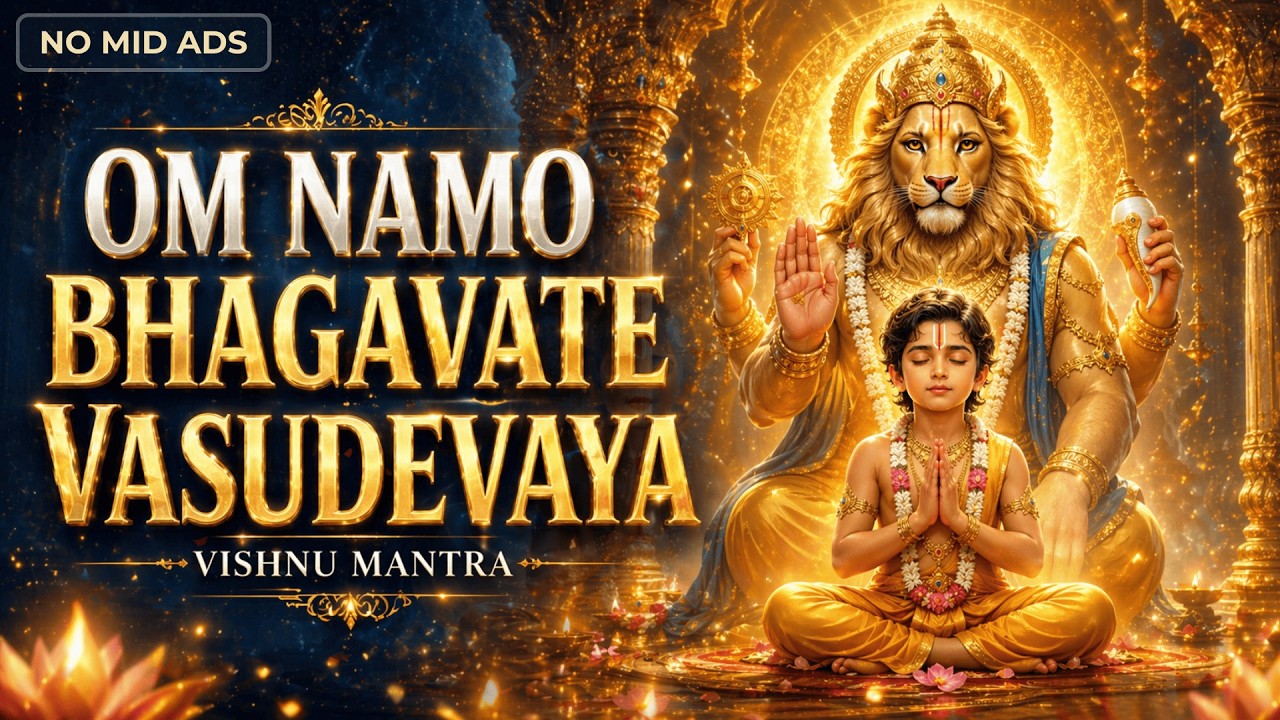
2h 8mOm Namo Bhagavate Vasudevaya
ॐ नमो भगवते वासुदेवाय नमः
 2h 24m
Shiva Gayatri Mantra — Rudra Gayatri
ॐ तत्पुरुषाय विद्महे महादेवाय धीमहि तन्नो रुद्रः प्रचोदयात् ॥
 2h 6m
2h 6mVande Dev Umapati — Shiva Stuti
वन्दे देव उमापतिं सुरगुरुं वन्दे जगत्कारणम् । वन्दे पन्नगभूषणं मृगधरं वन्दे पशूनां पतिम् । वन्दे सूर्यशशाङ्कवह्निनयनं वन्दे मुकुन्दप्रियम् । वन्दे भक्तजनाश्रयं च वरदं वन्दे शिवं शङ्करम् । ॐ नमः शिवाय ॥